Fleet safety violations hit more than your wallet – they disrupt schedules, raise insurance premiums, and damage CSA scores. Penalties vary wildly state to state, with fines reaching tens of thousands of dollars in places like Texas and California. For fleets crossing multiple jurisdictions, understanding these rules is not optional – it’s survival.
- California: Fines start at $16,285 for serious violations, doubling and tripling for repeat offenses.
- Texas: Overweight loads can cost up to $10,000, with intentional repeat violations hitting $30,000.
- New York: Overweight fines rise to $4,700, with jail time for heavy vehicles on restricted roads.
- Colorado: Winter chain laws and escalating fines for repeat offenses make compliance crucial.
- Florida: Texting violations can disqualify drivers, and unpaid fines may lead to vehicle seizures.
Fleet managers must plan routes carefully, track state-specific regulations, and enforce driver compliance to avoid fines that spiral out of control.
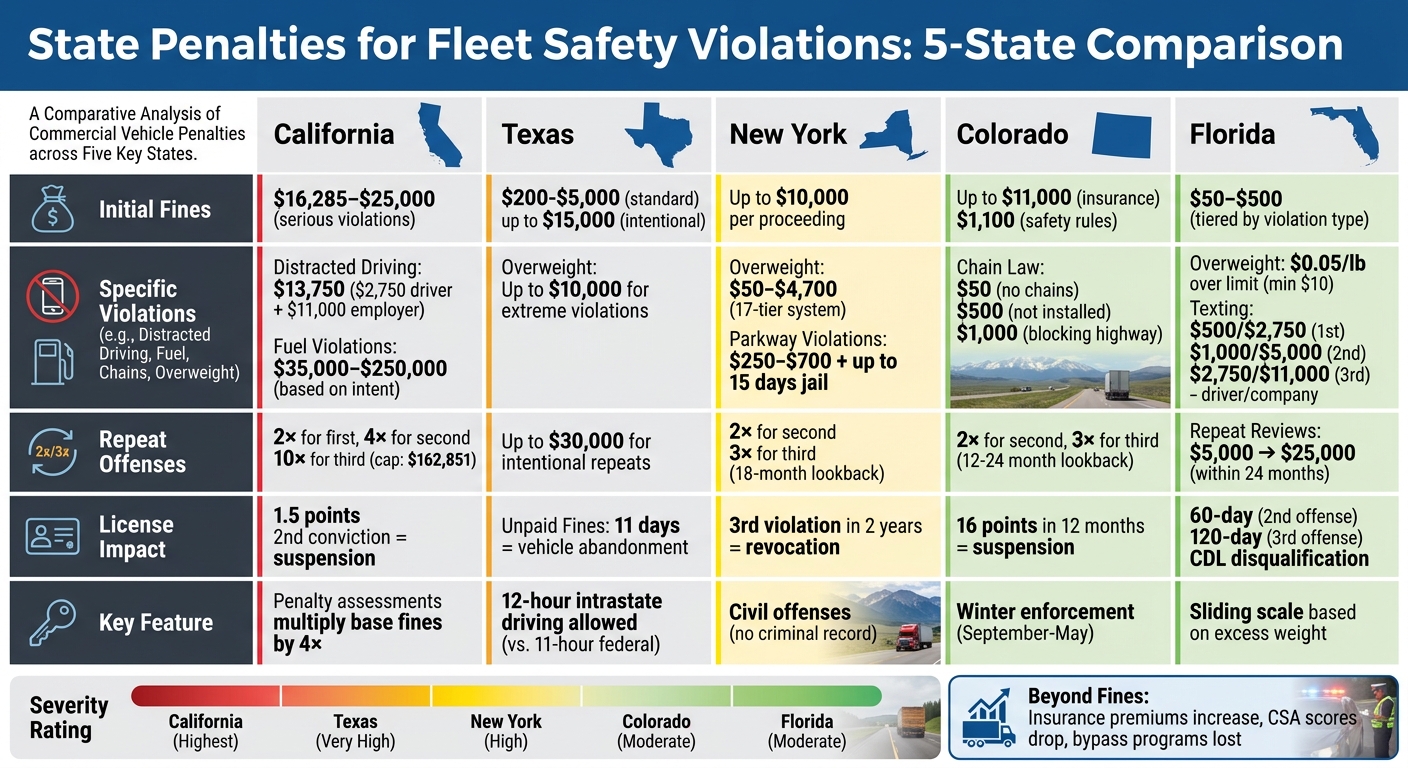
State-by-State Fleet Safety Violation Penalties Comparison Chart
1. California
Initial Violation Penalties
California enforces a combination of state Vehicle Code regulations and federal FMCSA rules, meaning violators face both state and federal consequences [7]. Cal/OSHA divides violations into three categories: Regulatory violations can result in fines up to $16,285, General violations range from $1,000 to $16,285 based on severity, and Serious violations start at $18,000 and can reach $25,000 [5].
Distracted driving comes with particularly harsh penalties. A single violation can cost $13,750 in federal fines – $2,750 for the driver and $11,000 for the employer [7]. In October 2024, a Sacramento logistics company faced a $33,000 fine after inspectors found three drivers using handheld phones during routine checks. This incident led to canceled deliveries and a scramble to replace personnel [7].
Fuel regulation violations are another costly area, with fines that vary based on intent. Infractions carry penalties of $35,000 for strict liability (e.g., paperwork errors), $50,000 for negligence, and up to $250,000 for willful violations [6].
Penalties for repeat offenses increase significantly, as outlined below.
Repeat Offender Escalation
For repeat violations, penalties multiply quickly: they double for the first offense, quadruple for the second, and increase tenfold for the third, capped at $162,851 [5]. Commercial drivers also face federal disqualification for repeated serious traffic violations. Two offenses within three years result in a 60-day suspension, while three offenses lead to a 120-day disqualification [7].
License Suspension/Revocation Thresholds
For commercial drivers caught using cell phones, the California DMV assigns 1.5 points under the Negligent Operator Treatment System. A second conviction within 36 months can result in a license suspension [7].
sbb-itb-09a90bb
2. Texas
Initial Violation Penalties
Texas enforces a tiered penalty system for towing fleets, overseen by the TxDMV, to address safety and compliance concerns. Administrative fines for standard violations can reach up to $5,000 per incident, while intentional violations may result in penalties as high as $15,000 [8][12].
The severity of penalties depends on factors such as the level of hazard posed, economic impact, prior violations, and efforts to correct the issue [8]. Persistent violations can lead to daily fines [8]. For safety-related violations under Chapter 644, Texas aligns its penalties with federal maximums instead of setting its own limits [10].
These towing vs. recovery violations fall into four classes:
- Class A: Missing required information, with fines ranging from $200 to $800.
- Class B: Expired permits, resulting in fines between $500 and $1,500.
- Class C: Safety-related failures, with penalties from $1,000 to $4,000.
- Class D: Insurance lapses, carrying fines of $2,000 to $5,000 [11].
This structured system differs from California’s approach, which includes higher fines and escalation factors.
Repeat Offender Escalation
Texas increases penalties for repeat violations to discourage ongoing non-compliance. For intentional repeat offenses, fines can total up to $30,000 [8][12]. Carriers with poor federal safety ratings or multiple Chapter 644 violations may face severe consequences, such as suspension, revocation, or denial of registration [9]. Unpaid fines can result in immediate operating bans and vehicle impoundment. If fines remain unpaid for 11 days, the vehicles may be classified as abandoned [10].
Administrative Fees
Carriers receiving a TxDMV notice of claim must respond – either by paying the fine or requesting a hearing – within 20 days [10]. Administrative proceedings can recover costs, fees, and attorney expenses, with all penalties directed to the state’s General Revenue Fund [8][12].
3. New York
Initial Violation Penalties
New York takes a rigorous approach to penalties, balancing weight-based fines with strict operational consequences. The state imposes penalties tailored to violation types and vehicle classifications. For safety rule violations, the Commissioner of Transportation can levy fines up to $10,000 in a single proceeding [16]. Operating without a valid permit or certificate starts as a traffic infraction, with fines ranging from $1,000 to $1,500. Repeat offenses within five years escalate to misdemeanors [16].
Overweight violations are handled through a detailed 17-tier system. Fines start at $50 for vehicles exceeding the limit by less than 2,000 pounds and rise to $4,700 for those exceeding limits by 45,000 pounds or more [14]. Parkway violations are weight-specific: vehicles under 10,000 pounds face $250 fines, while those over 26,000 pounds face $700 fines and up to 15 days in jail, even for first-time offenders [15]. Over-height violations result in $1,000 fines for first offenses and $2,000 for subsequent violations [15].
In 2017, New York recorded 12,838 large-truck crashes, with 32% resulting in personal injuries [15]. Crashes involving large trucks were more likely to involve multiple vehicles (87%) compared to other crash types (70%) [15].
Repeat Offender Escalation
New York enforces an 18-month look-back period for repeat offenses. Second offenses during this period double the fines, while third offenses triple them [15]. Vehicles over 26,000 pounds caught on parkways three times within 18 months face $2,000 fines and up to 90 days in jail [15]. The table below highlights how penalties escalate based on vehicle weight and offense frequency:
| Weight | 1st Violation | 2nd (within 18 mos) | 3rd+ (within 18 mos) |
|---|---|---|---|
| < 10,000 lbs | $250 | $500 | $750 |
| 10,000–26,000 lbs | $350 | $700 | $1,000 |
| > 26,000 lbs | $700 | $1,500 | $2,000 |
For towing fleets in New York City, the escalation window extends to two years. Non-compliance with insurance requirements results in steep penalties, starting at $2,500. A second offense triggers a 15-day suspension, while a third leads to mandatory license revocation [17]. Additionally, a third conviction for operating without a permit can result in court-ordered vehicle forfeiture [16].
License Suspension/Revocation Thresholds
New York enforces strict administrative measures beyond fines. In New York City, the third violation of specific administrative codes within two years results in automatic license revocation [17]. Insurance compliance failures carry severe consequences, escalating from 15-day suspensions to mandatory revocation [17]. Uninsured crashes lead to a mandatory one-year license revocation [13].
Vehicles with $350 or more in judgment debt are subject to booting or towing [19]. Additionally, the DMV suspends the registrations of all commercial vehicles owned or operated by individuals providing regulated transportation without a permit [16]. When multiple suspension-triggering violations occur simultaneously, the suspension periods typically run concurrently [17].
Administrative Fees
Administrative fees add further pressure on fleets with unpaid penalties. After four months, unsatisfied penalties become judgments. If left unresolved for 90 days, the fleet’s operating permit may be revoked without further hearing [16]. Restoring a license after revocation due to an uninsured crash requires a $750 civil penalty [13]. The state’s weigh-in-motion program can also impose a $25 penalty for failing to respond to notices within the required timeframe [18].
New York’s strict measures and clear escalation policies for repeat offenders highlight the state’s commitment to maintaining compliance and safety standards.
4. Colorado
Initial Violation Penalties
Colorado enforces fleet safety regulations under the oversight of the Colorado Public Utilities Commission and the Department of Public Safety. The state follows federal guidelines, specifically 49 CFR 386, subpart G, to determine penalties for violations [20].
The fines vary depending on the nature of the violation. For instance, failing to maintain the required insurance coverage can result in penalties as high as $11,000 [20]. General violations of motor carrier safety rules may lead to fines of up to $1,100 per violation [20]. Additionally, operating a vehicle without paying the annual identification fee could result in penalties of up to $400 [20].
Repeat Offender Escalation
Colorado imposes stricter penalties for repeat offenses. Under C.R.S. 42-20-407, fines double for a second violation within a 12-month period and triple for any subsequent violations within the same timeframe [21].
For other motor carrier violations under C.R.S. 40-7-113, the lookback period extends to 24 months. A second offense during this period can result in a fine twice the standard amount, while a third offense may incur a penalty three times the standard rate [20]. Compliance officers also have the authority to review up to three years of safety history when determining penalties [22].
License Suspension/Revocation Thresholds
Colorado uses a permit-based system to address fleet safety violations, particularly for carriers transporting hazardous materials. Permits can be suspended or revoked independently of the driver’s personal license [21]. Professional drivers are also subject to stricter point thresholds: 16 points in 12 months, 24 points in 24 months, or 28 points in 48 months can lead to suspension [21].
Carriers that fail to comply with a 30-day review risk having their registration canceled and being marked "out-of-service" by the FMCSA [22]. In addition, vehicles involved in hazardous materials violations may be immobilized for safety reasons [21].
Administrative Fees
Failing to pay civil penalties within 30 days results in registration cancellation by the Department of Revenue [20]. Once registration is canceled, the Colorado State Patrol informs the FMCSA, which then designates the carrier and its vehicles as out-of-service [22]. Vehicle registration for individuals with outstanding penalties will remain blocked until all fines are paid in full [20].
These policies reflect Colorado’s firm stance on maintaining fleet safety and its commitment to holding carriers accountable for violations.
5. Florida
Initial Violation Penalties
Florida uses a tiered penalty system to address violations. Minor infractions, like failing to display proper vehicle identification, result in a $50 fine. More serious issues, such as driver-related out-of-service violations or missing medical certificates under 49 C.F.R. s. 391.41, carry a $100 penalty [23].
For more severe violations, the fines increase significantly. Hazardous materials out-of-service violations and failing to register as a motor carrier each result in a $500 fine [23]. Overweight vehicle penalties are based on excess weight, with fines calculated at $0.05 per pound over the legal limit. However, if the excess is 200 pounds or less, the fine is a flat $10 [25][26]. Vehicles exceeding the maximum weight by more than 6,000 pounds must be unloaded at the owner’s expense before continuing [25].
Penalties grow harsher for repeat offenses.
Repeat Offender Escalation
Texting violations lead to escalating fines: $500 for the first offense, $1,000 for the second, and $2,750 for the third. Companies face even steeper penalties, with fines of $2,750, $5,000, and $11,000 for each respective offense. Compliance reviews that start with a $5,000 cap can jump to $25,000 for repeat violations within 24 months. If a second review within 12 months reveals ongoing noncompliance, the motor carrier could be barred from operating altogether [23].
These financial penalties are paired with strict measures targeting driving privileges.
License Suspension/Revocation Thresholds
A second texting offense results in a 60-day commercial driver’s license (CDL) disqualification, while a third offense leads to a 120-day suspension. Operating while out-of-service or failing to address fines can result in indefinite suspensions or revocations, particularly if the violation involves an accident [23][24][27]. Courts also have the authority to suspend or revoke driving privileges for violations tied to accidents, taking into account factors like fatalities, injuries, and property damage [24].
Administrative Fees
Unpaid fines can escalate into liens against the carrier’s assets, potentially leading to vehicle seizures. Additionally, vehicles with expired registrations for more than 90 days may be detained until proper documentation is provided [23][25].
Drivers and carriers can appeal penalties through the Commercial Motor Vehicle Review Board, which can adjust or overturn fines related to weight, fuel tax, or safety violations [23][25]. For weight violations issued via portable scales, drivers have the right to request verification at a fixed scale. If the fixed scale confirms compliance, the citation is dismissed [25].
Understanding FMCSA civil penalties
Pros and Cons
Each state’s penalty structure presents unique challenges and opportunities for fleet operators trying to balance compliance costs with operational efficiency. Variations in penalty severity, operational rules, and everyday impacts shape how carriers plan routes and manage risks.
| State | Penalty Severity | Operational Flexibility | Impact on Operations |
|---|---|---|---|
| California | High (base fines multiply 4× with penalty assessments) | Low (strict bridge formula and engine requirements) | High (55 mph truck speed limit extends trip times and requires equipment upgrades) |
| Texas | Very High (fines exceed $10,000 for extreme overweight) | High (12-hour intrastate driving allowed vs. federal 11-hour limit) | Moderate (standard speed limits) |
| New York | Moderate to High | High (violations treated as civil offenses, not criminal) | Moderate (no criminal record but steep fines still apply) |
| Colorado | Moderate (tiered chain law fines: $50 to $1,000) | Moderate (standard weight limits) | High (winter delays and added costs due to seasonal enforcement) |
| Florida | Moderate (sliding scale based on excess weight) | Moderate (standard federal baseline) | Low (lower and more predictable costs) |
These differences highlight how state policies affect fleet management strategies. Carriers must weigh these factors carefully to minimize risks and maintain operational efficiency, especially when planning routes that cross multiple states.
For example, California’s severe penalties go beyond base fines, with assessments multiplying costs significantly. The state’s 55 mph truck speed limit also extends trip durations, leading to higher labor expenses and increased operational costs.
In Texas, carriers benefit from the state’s allowance of 12 hours of intrastate driving – one hour more than the federal limit [1]. However, this flexibility comes with steep fines for weight violations, which can exceed $10,000 for loads more than 40,000 lbs over the legal limit [1]. Fleet managers must ensure drivers transition seamlessly between intrastate and interstate hauls, as federal Hours of Service (HOS) rules apply immediately upon crossing state lines.
"The only real leverage state governments have to achieve compliance with weight restrictions are fines high enough to cancel the extra profits obtained by operating over-loaded trucks." – Oversize.io [2]
New York offers a somewhat softer approach by treating most violations as civil offenses rather than criminal ones. While this spares drivers from a criminal record, the financial penalties remain substantial [2].
Colorado’s chain law system uses a tiered fine structure – $50 for failing to carry chains, $500 for not installing them when required, and $1,000 for blocking a highway [1]. Although predictable, these rules, combined with the September-to-May enforcement period, can cause significant delays and disruptions during winter months.
Beyond the immediate fines, carriers also face indirect costs. Insurance premiums rise with each citation, and poor Safety Measurement System (SMS) scores can disqualify fleets from bypass programs like PrePass. This forces trucks to stop at every weigh station, adding hours to delivery schedules. Repeat violations only compound these challenges, underscoring the broader issue of managing complex compliance costs effectively.
Conclusion
Fleet operators managing routes across multiple states face a web of penalties that vary widely by jurisdiction. In California, for instance, a base fine of $175 can climb to $753 once penalty assessments and court costs are added [2]. Meanwhile, Texas imposes fines exceeding $10,000 for severe overweight violations [1], and Colorado can charge up to $1,000 for highway-blocking offenses [1]. These differences make tailored compliance planning essential.
The best approach to compliance integrates regulatory requirements into financial planning rather than treating them as administrative tasks. Automated systems that track driver certifications and seasonal restrictions can help fleets avoid violations that could lead to escalating penalties, especially as stricter rules take effect in 2026 [3]. Since regulations differ so much between states, trucks that meet the legal standards in one jurisdiction might become non-compliant in another with lower weight limits [1].
"The smartest carriers treat compliance as a financial strategy, not an administrative burden." – SafeRoad Compliance [3]
Beyond fines, strict enforcement impacts overall operations. Repeat violations can lower CSA scores, increase insurance premiums, and disqualify carriers from weigh station bypass programs. Maintaining strong Safety Measurement System scores allows fleets to bypass weigh stations over 95% of the time, cutting fuel costs and minimizing delivery delays [1]. For fleets operating in California, ensuring CARB compliance is especially critical, as shippers face fines of up to $10,000 annually for hiring non-compliant carriers [1][4].
Seasonal regulations add another layer of complexity. In northern states, frost laws from February through June can lower legal axle weights by 25% to 35% [1]. Colorado enforces chain requirements from September through May [1]. Staying current with state DOT maps and leveraging automated compliance alerts are practical steps to avoid preventable citations that could lead to larger operational setbacks [1]. By addressing these challenges with state-specific compliance strategies, carriers can reduce financial risks and maintain smooth operations.
FAQs
Which violations most often trigger the biggest fines across states?
The steepest fines in various states typically arise from hours-of-service (HOS) violations and weight or size violations. For HOS violations, exceeding the limit by more than three hours can lead to penalties as high as $19,246 per infraction. Similarly, overweight or oversized loads face hefty fines aimed at protecting road infrastructure from damage. While issues like faulty brakes or lighting can also result in penalties, HOS and size/weight violations carry the highest financial consequences.
How do repeat-offense lookback periods differ by state?
States handle repeat-offense lookback periods for fleet safety violations differently, with timelines ranging from 12–36 months in some areas to as long as 5 years for more severe infractions. These variations shape how fleets approach compliance. Shorter lookback periods may lead to stricter penalties for recent violations, while extended timelines require fleets to adopt longer-term strategies to manage and address infractions effectively.
What steps can fleets take to avoid getting placed out-of-service?
Fleets can steer clear of out-of-service orders by prioritizing compliance with hours-of-service (HOS) regulations, maintaining precise records, and respecting driving limits. Routine vehicle inspections, consistent driver training, and active compliance monitoring play a key role in avoiding safety violations. Keeping up-to-date with federal and state rules, including weight limits and required permits, is equally critical. Building a strong safety-first mindset among drivers and staff ensures regulations are followed diligently, reducing the risk of violations.