When a crash or breakdown clogs Colorado Springs highways, clearing the road fast is about more than convenience – it’s about safety. Every minute a vehicle blocks traffic increases the risk of secondary crashes and delays emergency responders. Tow truck operators, like those at Knob Hill Towing, work with police and fire departments to remove vehicles efficiently, ensuring traffic flow resumes and first responders can do their jobs. From advanced tools like GPS navigation to specialized recovery techniques for heavy trucks or electric vehicles, the process requires precision and expertise.
Traffic incidents cause up to 30% of congestion delays in cities, and secondary crashes are often worse than the initial accident. Programs like Colorado’s TIM Track and incentives for quick clearance help reduce these risks. Tow operators face challenges like active traffic, liability concerns, and complex recoveries, but training and coordination make the difference. Knob Hill Towing’s Wreckmaster-certified drivers are equipped to handle everything from minor breakdowns to overturned tractor-trailers, keeping Colorado Springs roads safer for everyone.
Using Technology and Coordination to Prioritize Routes
Modern route clearance depends on a combination of advanced digital tools and close collaboration between agencies. Tow truck operators often receive detailed pre-arrival information from law enforcement and fire departments, including specifics about the vehicles involved, cargo details, and precise location coordinates[1].
GPS Navigation and Traffic Signal Systems for Faster Response
GPS tracking systems play a crucial role in guiding tow operators to emergency scenes quickly. These systems analyze traffic patterns and road conditions in real time, helping drivers avoid congestion and take the fastest route[8]. Automated digital dispatch systems further streamline operations by assigning tasks and tracking each step of the process, from the initial call to final clearance[8].
"GPS tracking not only enhances efficiency by optimizing routes but also improves safety by ensuring prompt assistance during emergencies." – Towing Recovery Rebuilding Assistance Services[8]
Mobile apps provide updates on estimated arrival times, while dynamic road signs inform drivers about closures. Platforms like Colorado’s TIM Track gather real-time data on incident durations and clearance times, enabling agencies to prioritize routes based on immediate needs[4][9]. These tools work in harmony with on-scene coordination efforts, ensuring that resources are deployed efficiently.
Working with Police and Fire Departments
Technology alone isn’t enough – effective route clearance also depends on strong interagency coordination. Tow truck operators work within the Incident Command System (ICS), a unified structure designed to reduce confusion about authority at the scene[5][6]. Regular "TIM team" meetings and joint training exercises help agencies clarify roles and prepare for emergencies before they occur[5][7].
At the scene, law enforcement focuses on securing the area and handling crash investigations, fire-rescue teams manage hazards, and tow operators handle vehicle recovery and debris removal[7]. Many state Departments of Transportation also offer specialized training programs and collaborate with state towing associations to develop efficient clearance strategies[3].
Some states, including eight that have adopted Towing Recovery Incentive Programs (TRIP), even provide financial incentives to towing companies that meet strict clearance timeframes. These programs are particularly effective in prioritizing emergency routes in high-traffic areas[3][5].
Local companies like Knob Hill Towing in Colorado demonstrate how integrating advanced technology with strong interagency partnerships can make a real difference in clearing routes quickly during critical incidents.
sbb-itb-09a90bb
Methods for Fast Vehicle Removal from Critical Areas
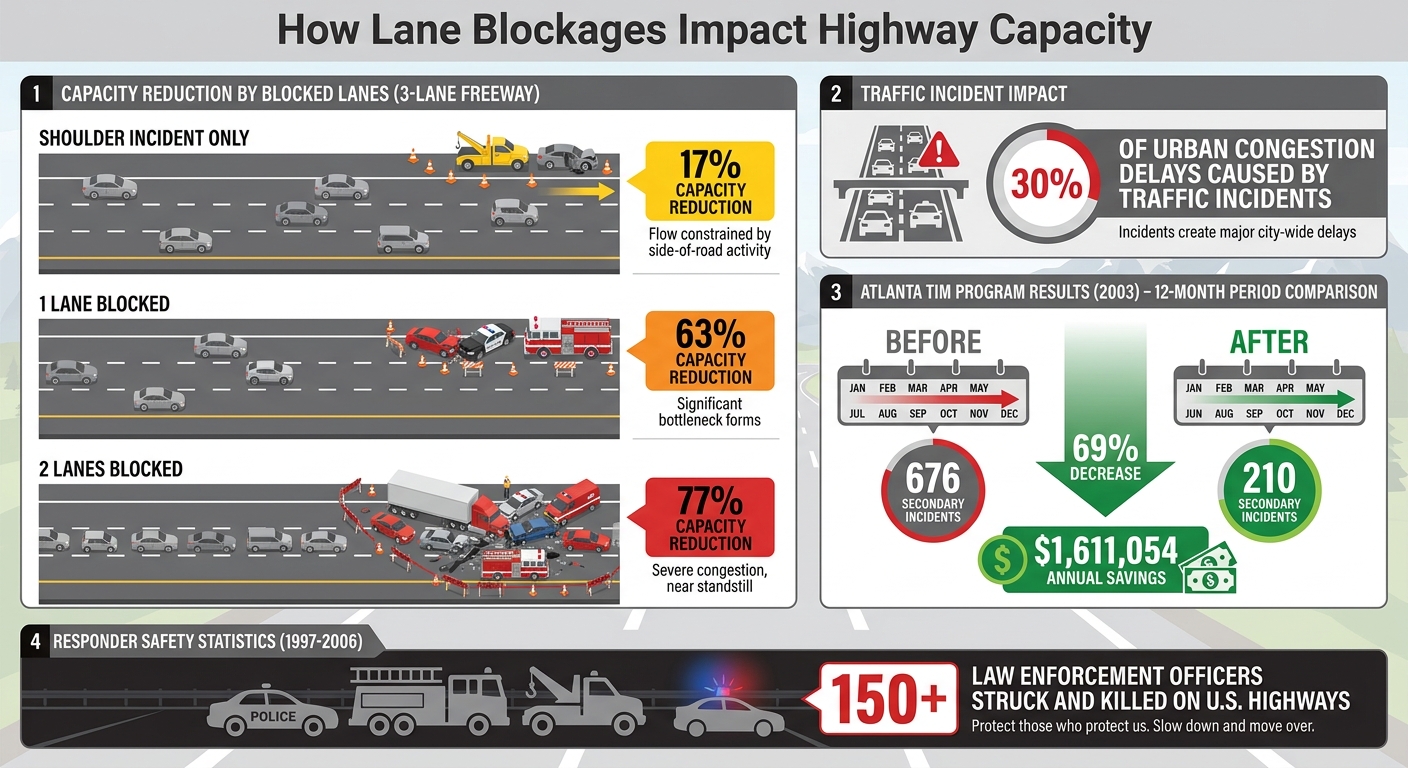
Impact of Lane Blockages on Highway Capacity and Secondary Crash Reduction
When tow operators arrive on the scene, their priority is to remove disabled vehicles quickly and safely. The approach depends on the type of vehicle, its condition, and its location on the road.
Vehicle Towing and Recovery Methods
Flatbed towing is the go-to method for safely clearing most passenger vehicles, particularly on highways and intersections. By lifting all wheels off the ground, this technique prevents drivetrain stress and minimizes the risk of further damage. It’s especially important for all-wheel-drive and electric vehicles.
For overturned large trucks, air cushion recovery systems are used. These systems rely on inflatable bags to upright vehicles without causing damage to the frame or cargo, which speeds up the clearance process[11].
In situations where vehicles are drivable but drivers cannot or will not move them, authority removal policies come into play. These allow responders to take decisive action, such as pushing or dragging damaged vehicles off travel lanes to restore traffic flow. Law enforcement and transportation agencies often use these policies, which are backed by the Federal Highway Administration, to safely reduce liability while clearing roads[2].
Some states also enforce laws requiring drivers involved in minor crashes to move their vehicles to safe areas. This allows tow operators to focus on major incidents, such as overturned trucks or multi-vehicle collisions[2].
In urban environments, where space is tight and traffic is heavy, precision and efficiency are equally critical.
Clearing Lanes in Urban and High-Traffic Areas
Urban areas present unique challenges due to limited space and continuous traffic. Even minor incidents can cause major disruptions. For example, blocking one lane on a three-lane freeway reduces capacity by 63%, while two blocked lanes cut capacity by 77%. Even incidents confined to the shoulder can reduce roadway capacity by as much as 17%[11].
To address these challenges, full-function service patrols equipped with push bumpers respond to minor incidents immediately. They move disabled vehicles to the shoulder before standard tow trucks arrive, minimizing disruptions. These patrols also set up traffic control devices – typically at least 16 cones arranged in a 250-foot taper with 20-foot spacing – to establish a safe work zone[10].
Operators use vehicle-mounted arrow panels to direct traffic around the scene. When a travel lane is blocked, the panel displays "Arrow" mode, switching to "Caution" mode for shoulder work[10]. Once traffic control measures are in place, responders reduce the intensity of their flashing lights to prevent rubbernecking and reduce the risk of secondary crashes[10].
Atlanta, Georgia’s Traffic Incident Management practices, launched in 2003, highlight the benefits of these strategies. Over 12 months, secondary incidents dropped by 69%, from 676 to 210, saving $1,611,054 annually[11].
Companies like Knob Hill Towing in Colorado Springs are equipped to meet these demands. Their Wreckmaster-certified drivers and heavy equipment hauling capacity – up to 110,000 lbs – enable them to handle everything from routine vehicle clearances to complex recovery efforts requiring specialized tools and expertise.
Safety Procedures for Emergency Towing Operations
Safety is the backbone of emergency towing, especially on busy roads where risks are ever-present. Every step, from traffic control to operator training, is designed to protect tow operators, motorists, and first responders.
Safety Measures for Highway Towing
Temporary traffic control is the cornerstone of safe highway towing. Operators use standardized traffic cone setups to create secure work zones, adhering to best practices for lane closures. Cones are placed while facing oncoming traffic to stay alert and positioned upstream toward approaching vehicles [10].
Vehicle-mounted arrow panels guide traffic safely around the scene. These panels are switched to "Arrow" mode when a travel lane is blocked and set to "Caution" mode for work on the shoulder. To avoid wind damage, arrow panels should not be used upright at speeds above 40 mph [10]. As the Federal Highway Administration points out, "Emergency lighting does not provide traffic control and is not considered a traffic control device" [10].
Tow truck placement is equally critical. Positioning the truck between the incident and oncoming traffic creates a buffer zone that significantly enhances safety. This measure is particularly important given that over 150 law enforcement officers were struck and killed on U.S. highways between 1997 and 2006 [12]. Combined with on-scene coordination, strategic vehicle placement ensures a safer environment for emergency operations. Operators also reassess traffic control setups about every 15 minutes to keep conditions secure and improve traffic flow [10].
While equipment and procedures are vital, the skills and training of operators are just as important.
Driver Training and Certification Requirements
The Towing & Recovery Operator Certification Program (TROCP) sets the benchmark for emergency towing standards. Introduced in June 2021 as a replacement for the National Driver Certification Program, TROCP offers three certification levels based on vehicle weight and recovery complexity: Level 1 for light-duty passenger vehicles, Level 2 for medium and heavy-duty trucks, and Level 3 for heavy recovery specialists managing overturned large vehicles, highlighting the towing vs. recovery differences in equipment and technique [13].
Many states and municipalities now require TROCP certification for operators participating in law enforcement towing rotations. By 2025, 26 state Departments of Transportation will rely on training programs as their primary method for collaborating with the towing industry [3]. Additionally, the National Traffic Incident Management (TIM) Responder Training equips operators with the tools to work effectively alongside police and fire departments during high-speed highway clearances [1][13]. Knob Hill Towing ensures its Wreckmaster-certified drivers are trained in these protocols, enabling them to manage even the most complex emergency scenarios. Rigorous training is the foundation that reinforces these safety measures, ensuring every operation is handled with precision and care.
Conclusion: Professional Towing Services and Route Clearance
Through advanced tools, specialized skills, and comprehensive training, professional tow operators play a critical role in ensuring quick route clearance. Their responsibilities extend far beyond towing vehicles. They manage temporary traffic control zones, collaborate with law enforcement and fire departments through established incident command systems, and continuously assess scenes to restore traffic flow and minimize secondary accidents [10].
"Quick clearance of all traffic incidents, large and small, is important not only for reducing traffic congestion and improving mobility on the highway network, but also for improving safety for travelers and incident responders."
The Federal Highway Administration emphasizes that such efficiency depends on skilled operators capable of managing complex clearance operations [2][10].
As highlighted earlier, certification programs equip operators to handle tasks ranging from simple breakdowns to intricate heavy vehicle recoveries [1]. Many law enforcement agencies mandate these certifications for participation in emergency response rotations, acknowledging that specialized knowledge directly influences both safety and clearance speed [1]. Knob Hill Towing employs a team of Wreckmaster-certified drivers trained in these critical protocols. With over 57 years of experience and as a trusted partner of the Colorado Springs Police Department, Knob Hill Towing delivers the expertise and coordination needed to manage emergency scenarios effectively across Colorado Springs and El Paso County.
Emergency towing saves lives, reduces the risk of secondary crashes, and quickly restores roadways to full capacity. Efficient route clearance remains essential for maintaining traffic flow and ensuring public safety during critical incidents.
FAQs
Who decides which lanes get cleared first at a crash scene?
At a crash scene, authorized officials – including law enforcement or incident responders – determine which lanes to clear first. Their decisions hinge on several factors, such as managing traffic flow, addressing safety risks, and assessing the severity of the situation.
What should I do if my car is disabled but still drivable after a minor crash?
If your car can still be driven after a minor accident, the first step is to move it to a safer spot, such as the shoulder or a nearby pull-off area. This clears the roadway, helping to prevent further accidents and easing traffic flow. Once you’re in a secure location, contact local authorities or a trusted roadside service like Knob Hill Towing for assistance. If there’s any doubt about the vehicle’s safety or if the damage might affect how it operates, avoid driving it further. Safety comes first.
How do tow operators safely recover heavy trucks or EVs without causing more damage?
Tow operators rely on advanced equipment and proven methods to handle the recovery of heavy trucks or EVs safely. Each recovery starts with a thorough assessment of the vehicle’s condition and the surrounding scene. This ensures the right techniques, like controlled winching or precise rigging, are used to prevent further damage. Clear coordination with law enforcement is also a key part of the process, maintaining safety and streamlining operations. Knob Hill Towing follows these practices closely, providing skilled recovery services for large vehicles and EVs throughout Colorado Springs and Southern Colorado.