When towing for long distances, understanding your vehicle’s limits is critical for safety, performance, and compliance with the law. Here’s what you need to know:
- Towing capacity is determined by your vehicle’s manufacturer and depends on key weight ratings: GVWR, GCWR, and GAWR.
- Overloading your vehicle can lead to brake failure, steering issues, voided warranties, and insurance problems.
- Calculate your towing capacity using this formula:
GCWR – (Curb Weight + Passengers + Cargo + Hitch Equipment) = Actual Towing Capacity. - Keep your load under 80% of your maximum towing capacity to allow for unexpected conditions like steep grades or shifting loads.
- Verify your calculations by weighing your vehicle and trailer on a certified scale.
- Proper tongue weight (10–15% of the trailer’s total weight) is essential to prevent sway and maintain control.
- For mountainous areas or high altitudes, adjust your capacity by reducing 2% per 1,000 feet above 1,000 feet.
- Follow state laws regarding towing speeds, trailer brakes, and equipment requirements to avoid fines or accidents.
By respecting your vehicle’s limits and preparing for long-haul challenges, you’ll ensure a safer, smoother towing experience.
For professional assistance, consider reaching out to experts like Knob Hill Towing for reliable support.
How much Can My Truck Tow..Safely! (Payload & Tow Capacity Explained)
sbb-itb-09a90bb
Find Your Vehicle’s Weight Ratings
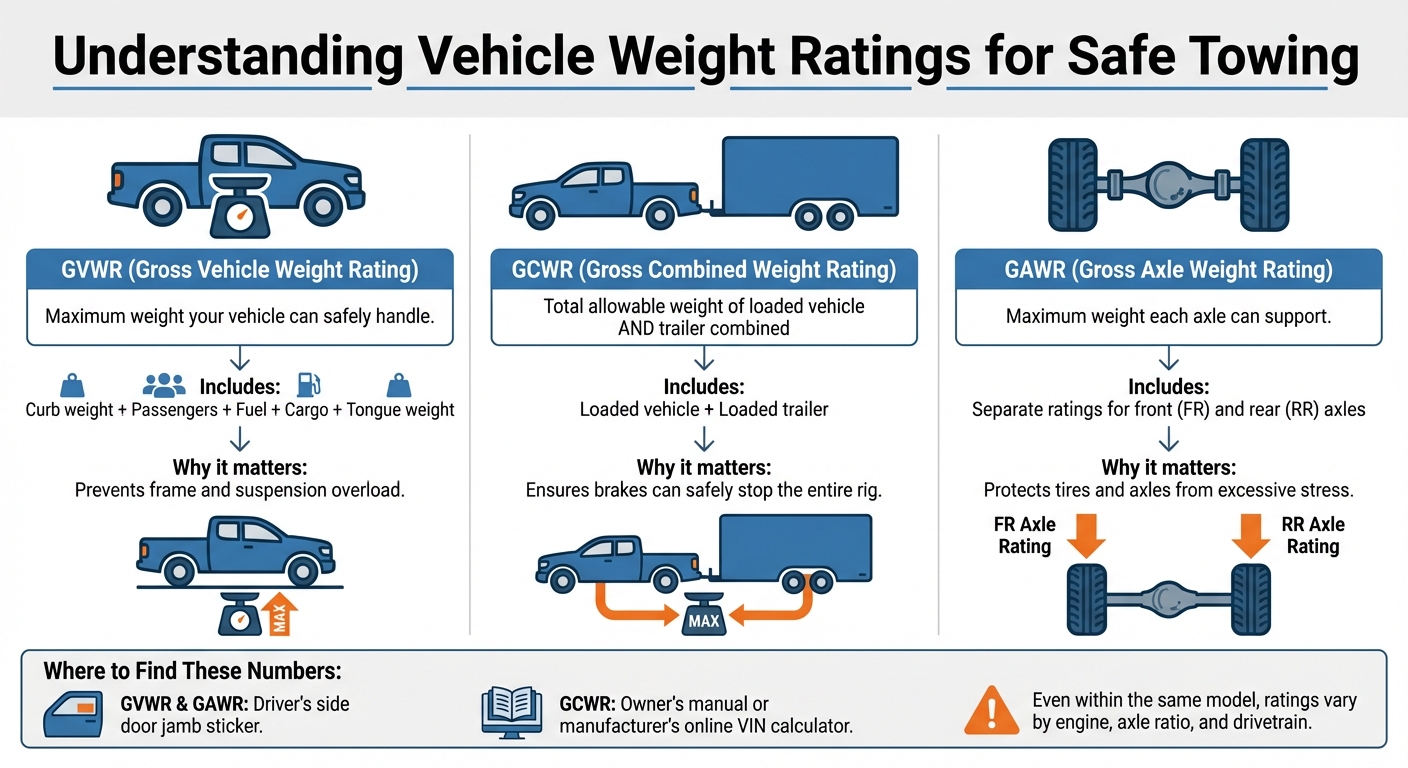
Vehicle Weight Ratings Comparison: GVWR vs GCWR vs GAWR
Before figuring out your towing capacity, you need to know three key numbers: GVWR, GCWR, and GAWR. These figures are essential for safe towing and help you avoid overloading your vehicle or trailer. Let’s break down what each one means and why it’s important.
Key Weight Metrics Explained
- GVWR (Gross Vehicle Weight Rating): This is the maximum weight your vehicle can safely handle, including its curb weight (the weight of the vehicle with fluids but no passengers or cargo), plus passengers, fuel, cargo, and tongue weight [9][4][5]. It ensures your vehicle isn’t carrying more than it’s designed to handle.
- GCWR (Gross Combined Weight Rating): This is the total allowable weight of your loaded vehicle and trailer combined [8][4][1]. It ensures the entire setup can be safely towed and stopped.
- GAWR (Gross Axle Weight Rating): This is the maximum weight each axle can support. Manufacturers provide separate ratings for the front (FR) and rear (RR) axles [1][5]. Even if your total weight is within limits, overloading a single axle can lead to tire blowouts or damage to your suspension.
Here’s a quick summary of how these ratings work together:
| Metric | What It Measures | Why It Matters |
|---|---|---|
| GVWR | Max weight of vehicle + passengers + cargo + tongue weight | Prevents frame and suspension overload |
| GCWR | Max weight of loaded vehicle + loaded trailer | Ensures brakes can safely stop the entire rig |
| GAWR | Max weight on a single axle (front or rear) | Protects tires and axles from excessive stress |
Where to Look for Weight Information
To find your GVWR and GAWR, check the driver’s side door jamb. Open the door and look near the latch for a sticker called the "Safety Compliance Certification Label." This sticker includes vehicle-specific ratings [8][9][3].
Finding GCWR can be trickier since it’s not always on the door sticker. Check your owner’s manual, usually in the "Towing" or "Technical Specifications" sections [4][3]. If the manual is missing or the sticker is worn out, many manufacturers, like Ram, provide online towing calculators. By entering your Vehicle Identification Number (VIN), you can get the exact ratings for your specific trim and equipment [3][5].
Keep in mind that towing capacity can vary even within the same model. Factors like engine size, axle ratio, wheelbase, and drivetrain (RWD vs. 4WD) all play a role [4]. Using your VIN ensures you’re working with precise numbers tailored to your configuration. Understanding these ratings is a critical first step in calculating your towing capacity.
Calculate Your Actual Towing Capacity
Now that you’ve got a handle on your vehicle’s weight ratings, it’s time to crunch the numbers. Manufacturers often advertise towing capacities based on ideal conditions – typically assuming a 150-lb driver and no additional cargo[3]. But in the real world, every extra pound – whether it’s passengers, luggage, or aftermarket equipment – chips away at that towing limit.
Use GCWR for a Precise Calculation
The best way to figure out your actual towing capacity is by using your vehicle’s Gross Combined Weight Rating (GCWR). Here’s the formula:
GCWR – (Curb Weight + Passengers + Cargo + Hitch Equipment) = Actual Towing Capacity[10]
Start with your GCWR. Subtract your vehicle’s curb weight (which includes fluids but excludes passengers and cargo). Then, subtract the weight of passengers, luggage, and any accessories like toolboxes, winches, or hitch hardware.
For example, let’s say your truck has a GCWR of 15,000 lbs and a curb weight of 5,000 lbs. That leaves you with 10,000 lbs of towing capacity. If you add 4,000 lbs of dirt to the truck bed, your remaining towing capacity drops to 6,000 lbs[10].
"Published towing specs assume the vehicle carries only the driver, not the family, friends, or the associated gear for the trip."
– Russ Heaps, Senior Editor, Kelley Blue Book[3]
Don’t forget the trailer’s tongue weight, which is the downward force on your hitch. This weight counts toward your vehicle’s payload capacity. For instance, towing a camper with a full 100-gallon water tank could add around 850 lbs[2].
Once you’ve done the math, verify your numbers by weighing your vehicle and trailer in real-world conditions.
Verify with Actual Weighing
After calculating your towing capacity, confirm it by measuring actual weights. Use a certified CAT scale for accuracy[6]. Weigh your vehicle twice: first, fully loaded with passengers, gear, and a full tank of fuel; then, with the trailer attached. This will give you a clear picture of how the weight is distributed between your vehicle and trailer, helping you stay within safe limits.
Many experts suggest staying below 80% of your maximum towing capacity to allow for a safety margin. For example, if your calculated capacity is 8,000 lbs, aim to tow no more than 6,400 lbs. This buffer provides extra room for braking, load shifts, and steep inclines[3].
Measure Trailer Weight and Balance the Load
Calculate Total Trailer Weight
The Gross Trailer Weight (GTW) is the combined weight of your trailer and everything inside it – cargo, water, propane, and gear. To figure out GTW, start with your trailer’s Unloaded Vehicle Weight (UVW), also called its "dry weight." You can usually find this on the VIN sticker or capacity plate located on the trailer’s front frame[2]. Next, add the weight of everything you’re packing. For instance, filling a 100-gallon water tank adds about 850 lbs.
To confirm the GTW, weigh the fully loaded rig at a truck scale, then weigh your tow vehicle separately. The difference between these two measurements gives you the trailer’s GTW.
"The lowest-rated piece of towing equipment will determine the most weight that can safely be towed." – Matt Barnes[13]
Always ensure that your GTW does not exceed the rating of the weakest component in your towing setup. This could be your hitch, ball mount, or even your vehicle’s towing capacity. Once you’ve determined the GTW, the next step is to balance the load by setting the correct tongue weight.
Set Proper Tongue Weight
Getting the tongue weight right is essential for a safe towing experience. Tongue weight refers to the downward force exerted on your hitch ball. For conventional bumper-pull trailers, this should be about 10–15% of the fully loaded trailer weight[12]. If the tongue weight is too low, the trailer can sway or fishtail dangerously. On the other hand, excessive tongue weight may overload your rear tires, reducing overall control of your vehicle[15].
To achieve the correct balance, aim to load 60% of your cargo ahead of the trailer axle and 40% behind[14]. Keep heavier items low and centered to enhance stability. If you notice trailer sway, shifting heavier items forward can help increase the tongue weight and stabilize the trailer.
For smaller trailers, you can measure tongue weight using a bathroom scale. Place the scale at hitch height using a box or cinder block for elevation. For heavier trailers, a commercial tongue-weight scale – usually priced between $150 and $350 – offers a more accurate measurement[12].
Account for Long-Distance Conditions
Once you’ve determined your towing capacity, it’s important to factor in conditions that can impact performance over long distances. These adjustments help ensure safety and protect your vehicle during demanding trips.
Adjust for Altitude and Steep Grades
Towing in high-altitude or mountainous areas can significantly affect your vehicle’s performance. At higher elevations, gas engines that rely on natural aspiration receive less oxygen, which reduces combustion efficiency. According to Ford, you should decrease your vehicle’s effective Gross Combined Weight Rating (GCWR) by 2% for every 1,000 feet above 1,000 feet[17]. While turbocharged engines like Ford’s EcoBoost can offset some of this loss by increasing turbo speed, they’re not immune to performance drops[17].
Steep grades, particularly those exceeding 6%, also place extra strain on your engine and brakes. For grades over 8%, employ techniques like engine braking or pulse braking to manage stress[16][19]. When descending, engage "Tow Mode" or manually shift to a lower gear to maintain control[16][19]. Pulse braking involves sharply reducing speed by 10–15 mph, releasing the brakes to let them cool, and then resuming your pace[16].
These strategies help prepare your vehicle for the added challenges of long-distance towing.
Leave a 10% Safety Buffer
Environmental factors like altitude, steep grades, and shifting loads make it critical to leave a margin for error. Towing at your vehicle’s maximum capacity is risky because it doesn’t account for unexpected variables. Experts recommend keeping your load at no more than 80% of your rated towing capacity to allow for these factors[3][6].
"For safety reasons, it’s best to never come within 20% of that total [maximum towing capacity]. Loads shift. People miscalculate. And, cars brake suddenly." – Kelley Blue Book[3]
This buffer not only improves safety but also reduces wear on key components like your drivetrain, suspension, and frame, extending your vehicle’s lifespan. If you’re towing a non-turbo gas engine through mountainous terrain, consider increasing this buffer to 20% for added protection[18].
Meet Legal and Equipment Standards
Once you’ve assessed your towing weight, the next step is ensuring your setup complies with legal and equipment standards. These rules aren’t just bureaucratic red tape – they’re designed to protect roads, vehicles, and, most importantly, lives. Ignoring them can lead to fines, delays at weigh stations, or even dangerous accidents caused by improper setups.
Know State Towing Laws
Understanding axle weight limits is a must. Federal law sets the standard at 20,000 lbs for single axles and 34,000 lbs for tandem axles on interstate highways. However, state regulations can vary widely. For instance, Florida allows double axles to carry up to 40,000 lbs, while Minnesota caps single axles at just 10,000 lbs[23].
Size restrictions also differ by state. Most states limit vehicle width to 8.5 feet and height to 13.5 to 14.5 feet, although Colorado permits heights up to 14.5 feet[7][22]. If your vehicle exceeds these dimensions, you’ll need an oversize permit. In Colorado, any setup with a GCWR (Gross Combined Weight Rating) over 26,000 lbs must stop at state ports of entry[7][20].
Safety equipment is another critical consideration. For example, trailers (excluding fifth-wheels) must be equipped with safety chains or cables that meet SAE J684 standards[21]. Trailers wider than 80 inches are required to have side marker lights and reflective tape[21]. Additionally, many states mandate independent braking systems with breakaway switches for trailers exceeding a specific weight threshold[21].
Knowing these laws helps you make informed decisions about your towing equipment and ensures a safer journey.
Select the Right Hitch and Gear
Once you’re clear on state regulations, it’s time to choose the right equipment. Your hitch class should match the weight of your load. For example:
- Class IV hitches: Handle up to 10,000 lbs with a 1,000-lb tongue weight.
- Class V hitches: Support up to 20,000 lbs with a 2,000-lb tongue weight[3].
For loads over 5,000 lbs that require Class IV or V hitches, a weight-distributing hitch with spring bars can help level the load and minimize trailer sway[3].
All towing equipment should adhere to SAE J2807 standards, which have been the industry benchmark since 2013[3]. These standards ensure that equipment is tested under extreme conditions, such as 12% grade launches and 100° heat on Arizona’s Davis Dam Grade[3]. However, the system’s capacity is always limited by its weakest component. For instance, if your hitch is rated for 5,000 lbs but your vehicle is rated for 3,500 lbs, your maximum capacity is 3,500 lbs[5].
When attaching safety chains, cross them in an "X" pattern beneath the trailer tongue to catch the coupler if it disconnects[21].
If you’re planning a long haul through Colorado or Southern Colorado, double-check that your towing setup is fully compliant with state regulations and meets all necessary equipment standards. For expert assistance, consider reaching out to Knob Hill Towing (https://knobhilltowing.com). Their certified drivers, quick response times, and dedication to customer satisfaction make them a reliable partner for safe towing.
Vehicle Towing Capacity Comparison
Once you’ve assessed your vehicle’s weight limits and legal requirements, it’s helpful to see how various vehicles stack up in towing performance. This comparison goes beyond just towing capacity – it includes factors like stability, braking, and long-term performance under load.
Sedans typically offer an average towing capacity of about 1,750 lbs, with a range between 1,000 and 3,900 lbs[25]. They’re best suited for lighter loads, such as small utility trailers or jet skis, due to their limited cooling and braking systems. On the other hand, compact and mid-size SUVs average around 3,700 lbs, with a range of 1,500 to 5,000 lbs[25]. These vehicles are capable of towing small boats or pop-up campers, though extended towing can put stress on their drivetrains.
When you step up to full-size SUVs, the towing capacity jumps to an average of 8,000 lbs, with some models reaching as high as 9,600 lbs[25]. These vehicles are great for hauling larger boats or mid-size travel trailers, making them ideal for long family trips. Mid-size trucks, like the 2025 Chevrolet Colorado (starting at $31,900), can tow up to 7,700 lbs[24], making them a versatile choice for campers and utility trailers. Meanwhile, full-size trucks take towing to another level, averaging about 12,000 lbs. For example, the 2025 Ford F-150 (starting at $39,445) offers a maximum towing capacity of 13,500 lbs[40, 41], making it a popular option for towing large travel trailers or horse trailers.
Heavy-duty trucks are the ultimate towing machines, with an average capacity of around 22,000 lbs and the ability to handle up to 40,000 lbs for gooseneck trailers[41, 3]. The 2025 Ford F-450 Super Duty leads the pack with a massive 40,000 lbs towing capacity[27], while the 2025 Ram 3500 (starting at $48,565) is rated for 36,610 lbs[24]. These trucks are specifically designed for heavy-duty tasks like hauling fifth-wheel campers or heavy machinery, featuring reinforced frames and advanced cooling systems to handle the load over long distances.
"Ignoring the vehicle manufacturer’s towing requirements can affect the truck’s warranty, and from a legal perspective, towing beyond the specified limits may place all the liability on the driver’s shoulders in the event of an accident." – Mark Williams, Editor at PickupTrucks.com[26]
Towing capacity also ties directly to tongue weight limits. Sedans equipped with Class I hitches can typically handle about 200 lbs of tongue weight, while heavy-duty trucks with Class V hitches can manage between 2,000 and 4,000 lbs[3, 2]. To avoid overheating and excessive wear, it’s wise to maintain a 10–20% safety buffer within your vehicle’s towing limits[3].
Conclusion
Figuring out your towing capacity is all about being thorough and prioritizing safety. Start by double-checking your vehicle’s weight ratings and calculating your towing capacity by subtracting added loads from the GCWR. To ensure accuracy, weigh your fully loaded trailer on a certified scale. And don’t forget – keeping the tongue weight between 10% and 15% of the trailer’s total weight helps prevent dangerous sway. These steps, as outlined earlier, are key to setting up a safe towing system.
If you’re planning a long trip, extra care is crucial. Conditions like steep hills, high altitudes, and extreme heat can put significant stress on your engine and brakes. To stay on the safe side, many experts recommend following the 80% rule: avoid towing loads that exceed 80% of your vehicle’s maximum towing capacity[3]. This rule provides a safety cushion for unexpected challenges like shifting loads or tough road conditions.
Staying within your towing limits isn’t just about protecting your vehicle – it’s also about protecting yourself legally and financially. Overloading can lead to warranty issues, insurance complications, and even personal liability in the event of an accident[3]. Keep in mind that your towing setup is only as strong as its weakest link. For instance, if your hitch is rated for 5,000 lbs but your truck can handle 8,000 lbs, you’re limited to towing no more than 5,000 lbs[11].
Finally, always perform a pre-trip check. Take a few minutes to recheck your numbers, inspect your towing setup, and plan your route to avoid steep grades and ensure access to weigh stations. These small steps can make a big difference in preventing problems on the road.
If you need professional help, Knob Hill Towing is available 24/7 in Colorado Springs and Southern Colorado to assist with all your towing needs.
FAQs
How can I find my vehicle’s GCWR if it’s not listed on the door sticker?
If the Gross Combined Weight Rating (GCWR) isn’t listed on the door sticker, don’t worry – you can usually track it down in your vehicle’s owner’s manual or by looking up the manufacturer’s specifications. Another option is to search online using your vehicle’s VIN (Vehicle Identification Number) or contact your dealership for accurate information.
Understanding your GCWR is critical for determining your towing capacity. It ensures that your towing setup is safe and works as intended, especially for long hauls. If you’re unsure or need expert advice, consulting a professional towing service like Knob Hill Towing can provide the guidance you need.
Why should I only tow up to 80% of my vehicle’s maximum towing capacity?
Towing around 80% of your vehicle’s maximum capacity is a widely recommended practice for a safer and smoother experience. While your vehicle might technically be capable of handling its full towing capacity, staying below that threshold provides an extra layer of safety. This cushion helps account for things like sudden weight shifts, wind resistance, or challenging terrain.
Operating within this range also reduces the strain on key components such as the engine, brakes, and transmission, especially during long trips. To ensure everything goes smoothly, always check your vehicle’s owner manual for towing guidelines and make sure your load is evenly balanced and securely fastened. This simple step can make a big difference in protecting your vehicle and ensuring a safer journey.
What should I consider when towing at high altitudes?
When towing at higher altitudes, the thinner air can reduce engine performance, particularly in gasoline-powered vehicles. To adjust for this, it’s recommended to lower your vehicle’s gross combined weight rating (GCWR) by about 2% for every 1,000 feet of elevation above 1,000 feet. For example, if you’re towing at 10,000 feet, you might need to reduce the tow weight by approximately 20% to ensure safety. While gasoline engines experience the most noticeable impact, even diesel and turbocharged engines benefit from lighter loads in these conditions.
Here are some tips to help you tow safely at altitude:
- Use lower gears on steep climbs to maintain engine torque and prevent strain.
- Keep an eye on engine and transmission temperatures to avoid overheating.
- Inspect your brakes and rely on trailer brakes to maintain control during descents.
- Adjust tire pressure slightly higher to compensate for the lower air density.
If you’re unsure about calculating safe towing limits or need assistance preparing for high-altitude trips, Knob Hill Towing provides expert guidance and 24/7 support in Colorado Springs and across Southern Colorado.