When handling vehicles over 33,000 pounds GVWR, training is not optional – it’s essential. Heavy-duty towing requires advanced skills in rigging, safety protocols, and compliance with federal regulations. Certifications like the TROCP™ Level 3 ensure operators are prepared for the most demanding recoveries, from tractor-trailers to electric vehicles. The stakes are high: improper towing can lead to catastrophic damage or safety risks. Knob Hill Towing’s Wreckmaster-certified team follows these rigorous standards, offering expert service across Colorado Springs and beyond. Whether you’re managing a fleet or facing a roadside emergency, trust the team that knows the job inside and out.
District 4 Heavy Tow Truck Training | NMDOT
sbb-itb-09a90bb
Hazard Recognition and Scene Safety
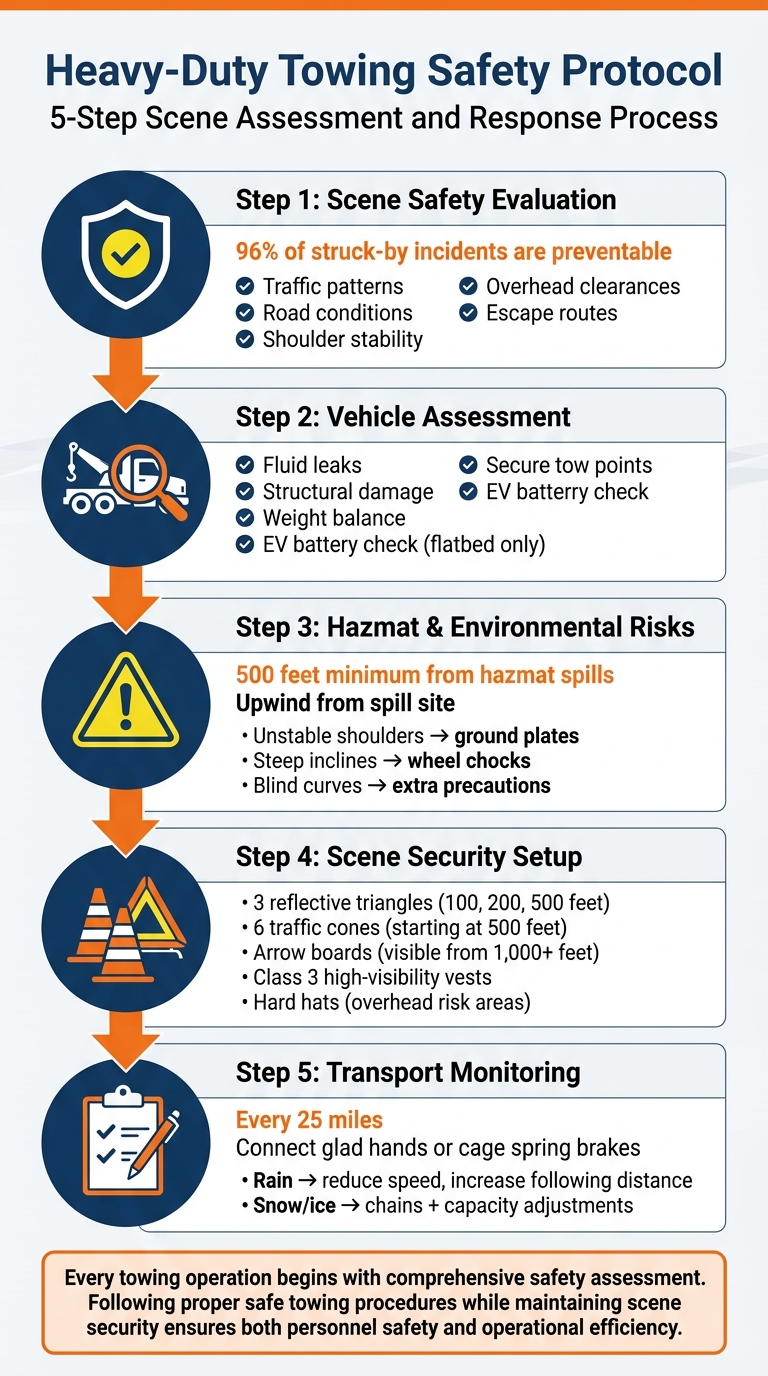
Heavy-Duty Towing Safety Protocol: 5-Step Scene Assessment and Response Process
Heavy-duty towing starts with a careful safety evaluation. The training highlights that struck-by incidents from passing traffic are the greatest risk in towing operations. However, 96% of these incidents can be avoided by following proper safety measures [7]. Operators are trained to assess the scene thoroughly before any equipment is used on the disabled vehicle.
Identifying Common Roadside Hazards
Operators systematically evaluate the scene, considering factors like traffic patterns, road conditions, shoulder stability, overhead clearances, and available escape routes [7]. For the vehicle itself, they check for fluid leaks, structural damage, weight balance, and secure tow points before proceeding [6][7].
Environmental risks, such as unstable shoulders that require ground plates, steep inclines needing wheel chocks, and blind curves that limit visibility, call for extra precautions [7]. In cases of suspected hazardous material spills, operators are trained to keep a minimum distance of 500 feet and position the tow truck upwind [7]. Electric vehicles pose additional challenges – lithium-ion batteries cannot tolerate wheel-lift towing on a driven axle without risking severe damage, making flatbed towing the only viable option [5].
These evaluations are essential for establishing safety procedures during emergency towing and recovery operations.
Safety Protocols and Emergency Response
The Traffic Incident Management (TIM) framework sets clear guidelines for securing the scene. Operators use at least three reflective triangles (placed at 100, 200, and 500 feet) and six traffic cones (starting at 500 feet), ensuring arrow boards are visible from over 1,000 feet [7]. All team members wear Class 3 high-visibility vests and hard hats when working in areas with overhead risks [7].
"Every towing operation begins with comprehensive safety assessment. Following proper safe towing procedures while maintaining scene security ensures both personnel safety and operational efficiency." – Heavy Vehicle Inspection [7]
During transport, operators inspect load security every 25 miles. For vehicles with air brakes, they connect glad hands or cage the spring brakes. Weather conditions also influence procedures – operators reduce speed and increase following distance in rain, while snow and ice require chains and adjustments to towing capacity [6][7].
Vehicle Stabilization and Lifting Techniques
Before any lifting begins, operators must stabilize the disabled vehicle after conducting a thorough hazard assessment and ensuring the scene is safe. Genesis Rescue Systems teaches an essential rule: "All vehicles are presumed to be unstable until we have put measures in place to stabilize it" [10]. This principle becomes even more critical when working with vehicles exceeding 33,000 pounds.
Stabilization Methods for Heavy Vehicles
Stabilization hinges on creating a "triangle of support." This involves combining a high attachment point, a low strut base, and a low strap connection to form a stable structure. To prevent unintended movement while applying tension, operators should first crib the offside void. On sloped terrain, tie-offs or cribbing are essential to secure the vehicle before attempting advanced recovery steps. For vehicles positioned sideways, the process involves securing the vehicle with a strut and cribbing, followed by applying minimal strap tension to avoid shifting [10].
Once stabilization is complete, the focus shifts to selecting the right lifting equipment and operating it effectively.
Lifting Equipment Operation
The choice of lifting equipment depends on the vehicle’s GVWR (Gross Vehicle Weight Rating) and requires a safety margin of at least 1.5 times the weight [11]. Heavy wreckers equipped with underlift systems can handle Class 8 trucks weighing up to 80,000 pounds. For articulated vehicles weighing up to 105,000 pounds, rotator units are necessary [11]. Flatbed carriers are ideal for minimizing drivetrain stress, making them suitable for all-wheel-drive, electric, and low-clearance vehicles [12].
Before transporting the vehicle, operators should perform a 360-degree inspection to confirm proper clearances, functional brakes, and secure connections [11].
According to Sarah Mitchell, Fleet Safety Director at National Transport Inc., standardized towing procedures have significantly reduced secondary damage claims and cut towing costs by 45% [11].
Heavy Rigging and Towing Equipment Operations
Mastering stabilization and lifting is just the beginning for heavy-duty towing operators. Once those skills are solid, operators move into more advanced areas like specialized rigging and load calculations. These are critical for safely managing the more complex recovery operations they’ll face.
Rigging Basics and Load Calculations
Rigging starts with understanding how sling angles impact load capacity. For example, at a 90° angle, the load factor is 1.000. As the angle decreases, the load factor increases: it’s 1.154 at 60°, 1.414 at 45°, and doubles to 2.000 at 30°[16].
To determine the correct sling capacity, operators divide the total load by the number of sling legs, apply the appropriate load factor for the angle, and then multiply to find the capacity for each leg[16]. Beyond this, operators must ensure the combined weight of the recovery rig and the disabled vehicle stays within the Federal Highway Administration’s legal axle-load limits[12]. Rigging accessories like safety chains, load binders, and tie-down straps must also meet the minimum breaking-strength requirements outlined in 49 CFR Part 393[12].
Tools such as load cells and dynamometers play a key role by providing real-time weight data. This helps prevent equipment overload and ensures proper weight distribution throughout the recovery process[14].
Once operators are proficient in rigging and load calculations, they move on to mastering rotator tow trucks for more demanding recovery scenarios.
Operating Rotator Tow Trucks
Rotator tow trucks are indispensable for accident recoveries and complex vehicle uprighting[6]. Their 360° boom rotation allows for precision handling in tight and challenging situations. Training on these units includes controlling boom extension, managing rotation speed, operating winches, and deploying stabilizers[1][15].
Before using a rotator, operators must conduct a thorough safety assessment. This includes checking the weight and dimensions of the vehicle, looking for fluid leaks, and inspecting structural integrity[6]. Recovery equipment must be rated to handle at least 1.5 times the actual load for safety[6]. Additionally, when calculating towing capacity, operators factor in a 25% margin to account for dynamic forces like acceleration and braking[6]. Safety protocols also require setting up warning devices and coordinating with law enforcement before starting rotator operations[6].
These advanced techniques reflect the high standards of top certifications for heavy-duty towing and are essential for ensuring safe and effective recovery operations.
Regulations and Industry Standards
Heavy-duty towing operators face rigorous federal and state regulations. Training programs are designed to help operators understand these rules to avoid fines, suspensions, or even impoundments.
DOT Compliance and Safety Inspections
Tow trucks with a Gross Vehicle Weight Rating (GVWR) over 10,001 pounds are classified as Commercial Motor Vehicles by the Federal Motor Carrier Safety Administration (FMCSA). These vehicles must follow FMCSA regulations outlined in 49 CFR Part 396. Operators managing vehicles or combinations exceeding 26,001 pounds need a Class A or B Commercial Driver’s License (CDL) and must participate in drug and alcohol testing as required by 49 CFR Part 382. Training programs include an eight-system pre-trip inspection process, covering areas such as brakes, steering, lighting, tires, coupling and lifting equipment, hydraulic systems, safety chains, and emergency gear [8].
Any defects must be documented in a Driver Vehicle Inspection Report (DVIR), and vehicles must undergo an annual inspection under 49 CFR Part 396.17. For Class 8 heavy-duty recovery trucks, this process typically takes 35–45 minutes and includes checks like rotator boom calibration, outrigger pad assessment, and wire rope condition verification [8].
Cargo securement is another critical area, governed by 49 CFR Part 393. Operators must ensure that tiedowns have an Aggregate Working Load Limit (AWLL) of at least 50% of the cargo’s weight. Loads must be inspected within the first 5 miles of travel and then every 3 hours or 150 miles thereafter. Federal rules also require one tiedown for every 10 feet of cargo length [8][17]. Additionally, Hours of Service (HOS) regulations under 49 CFR Part 395 limit drivers to 11 hours of driving within a 14-hour window after 10 consecutive off-duty hours, though emergency exemptions may apply during roadside recoveries [8].
Colorado Public Utilities Commission Guidelines
Beyond federal regulations, Colorado enforces its own towing rules through the Public Utilities Commission (PUC). Towing carriers in the state must adhere to specific fee structures set by the PUC. Starting November 1, 2025, the application fee for towing carriers will be $515.00, and vehicle stamp fees will increase to $51.00 per truck on November 15, 2025. Personal property release services are billed at $102.28 per hour, while nonconsensual releases requiring partial payments incur a 15% fee, capped at $60.
Operators in Colorado are required to maintain valid PUC permits and ensure each tow truck in their fleet has an up-to-date vehicle stamp. Together, these federal and state regulations create a complex compliance framework that heavy-duty towing professionals must navigate daily. Training programs are essential for helping operators stay informed and prepared.
Hands-On Recovery Drills and Practical Assessments
Theoretical knowledge is only part of the equation – practical recovery drills are essential to ensure operators are prepared for the challenges they’ll face on the job. Training programs include simulated scenarios and formal assessments to build confidence and competence in handling difficult situations.
Simulated Recovery Scenarios
Hands-on drills are designed to tackle complex recovery operations that go beyond basic towing. These include tasks like uprighting overturned tractor-trailers, pulling vehicles from ditches or rough terrain, and managing accident recoveries [2][13]. Some advanced programs even cover specialized scenarios, such as underwater recoveries or handling aircraft [13].
"Training scenarios are designed to mirror real working conditions, allowing participants to apply best practices using modern equipment and industry-accepted procedures." – American Towing & Recovery Institute (ATRI) [18]
During these exercises, operators learn to factor in critical resistance forces – such as surface resistance, damage resistance, and weight transfer [2][19]. They also gain experience with specialized tools like rotators, heavy-duty winches, wire ropes, snatch blocks, and towing air cushions [2][13][19]. Before any recovery begins, operators must conduct detailed risk assessments to ensure safety at every step [18].
These drills culminate in practical assessments that measure an operator’s ability to handle real-world emergencies with precision.
Evaluation and Certification
Practical assessments are structured to validate an operator’s readiness through realistic recovery tasks focused on safety. Operators are tested on pre-towing safety checks, including documenting vehicle damage, inspecting for fluid leaks, and verifying brake release functionality. They must also demonstrate proper alignment of recovery vehicles, choose appropriate attachment points, and calculate total towing weight – ensuring no equipment exceeds 80% of its rated capacity [20].
The Towing & Recovery Operator Certification Program® (TROCP®) Level 3 sets the benchmark for heavy-duty operators. This certification requires renewal every five years to ensure operators stay current with industry standards and techniques [2].
Knob Hill Towing: Heavy-Duty Towing Expertise
Knob Hill Towing has built its reputation on advanced training, cutting-edge equipment, and a commitment to handling the most challenging heavy-duty towing situations. Their approach reflects the rigorous standards found in professional heavy-duty towing training programs.
Wreckmaster-Certified Team and Safety Standards
Knob Hill Towing’s team of drivers holds Wreckmaster certifications through the TROCP® program, ensuring they meet the highest standards in the industry. Each heavy-duty specialist is certified at Level 2 for Medium/Heavy Duty, covering essential topics like chassis specs, lift capacities, and intermediate rigging techniques involving wire ropes, chains, and snatch blocks. For more complex recoveries, such as uprighting overturned vehicles or extracting tractor-trailers, operators achieve Level 3 certification, which focuses on advanced winching techniques and calculating resistance forces tied to surface conditions, damage, and weight distribution.
Safety is a top priority. Beyond certifications, drivers undergo Traffic Incident Management training and follow MUTCD standards to maintain safe roadside operations. They also comply with FMCSR guidelines and complete CPR and First Aid training to handle potential medical emergencies on the scene. These measures ensure both the safety of the operators and those involved in recovery situations[4][3].
The company operates under Colorado Public Utilities Commission permit T-04831 and adheres to state and federal regulations for heavy-duty recovery. Its fleet includes rotator tow trucks, heavy-duty winches, and specialized rigging equipment, making it capable of handling a wide range of recovery challenges[4].
Service Area Coverage
Knob Hill Towing provides 24/7 heavy-duty towing and recovery services across Colorado Springs, El Paso County, and Southern Colorado. As a trusted partner of the Colorado Springs Police Department for law enforcement-ordered recoveries, the company is equipped to handle high-pressure scenarios. Their fleet includes Landoll, Lowboy/RGN, and Beaver Tail trailers capable of hauling up to 110,000 pounds, making them a go-to resource for commercial truck accidents and construction equipment transport.
Knob Hill Towing’s DOT registration extends their reach beyond Colorado, offering long-distance recovery services in Texas, Arizona, Nebraska, and Ohio. Every call is answered by a live operator, ensuring immediate and effective coordination during emergencies or complex recovery operations. Whether it’s a highway breakdown or a large-scale recovery, Knob Hill Towing has the tools and expertise to get the job done.
Conclusion
The training modules described above highlight the critical importance of advanced education in heavy-duty towing. This field requires expertise in handling vehicles exceeding 33,000 pounds GVWR, involving complex equipment, advanced rigging techniques, and strict adherence to safety protocols[1].
"Continuing education is essential in any career, especially for those working as heavy duty tow operators." – Towing and Recovery Association of America, Inc. (TRAA)[13]
Proper training is not just about skill development – it directly influences liability protection and regulatory compliance. Certification programs like TROCP establish clear competency benchmarks, distinguishing licensed operators from those without proper credentials. This distinction is crucial when determining liability during service calls. Employing unqualified drivers can lead to FMCSA penalties reaching $16,000 per violation[9].
Education also enhances recovery outcomes while minimizing risks. Operators trained in resistance calculations, load dynamics, and specialized rigging can recover overturned or submerged vehicles without causing further damage. This is particularly important for emerging challenges, such as electric vehicle recovery, where incorrect towing methods can severely damage batteries and drivetrains[3].
In addition to technical expertise, training in Traffic Incident Management and MUTCD standards ensures operators can safeguard themselves and the public during roadside operations. By mastering these skills, professionals are better equipped to handle even the most demanding recovery scenarios while maintaining the highest standards in the industry. This comprehensive approach prepares operators to manage complex recoveries with confidence and precision.
FAQs
When do I need heavy-duty towing instead of standard towing?
Heavy-duty towing comes into play when dealing with vehicles or loads that weigh over 26,000 pounds GVWR. This includes commercial trucks, RVs, buses, and construction equipment. Handling such massive loads demands specialized equipment and the expertise to ensure recovery and transport are carried out safely.
How can I tell if a tow operator is certified for heavy recoveries?
Certified tow operators specializing in heavy recoveries undergo rigorous training programs, such as the TROCP® Level 3 – Heavy Recovery Specialist. This certification demonstrates their expertise in managing complex recoveries and handling heavy loads safely. Additionally, credentials from the National Driver Certification Program® (NDCP) and strict compliance with recognized safety and operational standards further validate their qualifications and readiness for demanding recovery scenarios.
What’s the safest way to tow an electric vehicle after a breakdown or crash?
The best way to tow an electric vehicle (EV) is by using a flatbed tow truck. This method keeps all four wheels off the ground, protecting the high-voltage battery and sensitive electronics from harm.
Before loading, make sure to activate the EV’s tow mode or transport mode. This step is crucial for safe handling. Also, let the tow operator know the vehicle is electric so they can follow the proper procedures and avoid costly damage.